If you are a man in Miami who has started noticing your hairline receding or your crown thinning, you are not alone. Male pattern hair loss affects millions of men and most of them wait too long before doing anything about it. By the time most men seek help, some of their best non-surgical options are already off the table. Men across Miami are increasingly exploring PRP for hair loss in Miami as a physician-guided, non-surgical approach to hair restoration — one that works best when started early, before significant follicle activity has declined. This blog explains what PRP therapy for male hair loss involves, what the clinical research supports, and how NeoMedicine Institute evaluates and approaches treatment.
What Is Actually Happening When Men Lose Their Hair
Male pattern hair loss, medically called androgenetic alopecia, is the most common form of hair loss in men. It affects an estimated 50 percent of men by age 50. The condition is driven by a combination of genetics and a hormone called dihydrotestosterone (DHT), which is produced from testosterone.
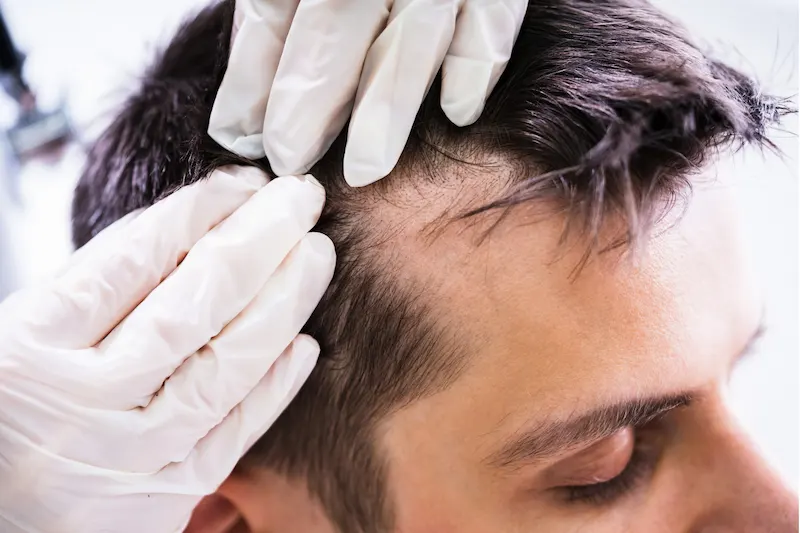
DHT attaches to hair follicles and causes them to shrink gradually over time. As follicles shrink they produce thinner and shorter hairs until they eventually stop producing hair altogether. The pattern typically starts at the temples and crown and progresses in stages classified by the Hamilton-Norwood scale, a clinical tool physicians use to assess how far hair loss has progressed.
Most men recognize hair loss is happening but are not sure when to act. These are the early signs worth taking seriously:
- A gradually receding hairline at the temples
- Thinning at the crown that becomes visible under certain lighting
- More hair shedding than usual in the shower or on a pillow
- A wider part line or reduced density across the top of the scalp
- Hair that looks thinner in diameter even when coverage still seems adequate
The important thing to understand is that follicles in early stages of thinning are still active. Follicles that have been dormant for years may not be. The earlier the evaluation, the more options remain available.
What Is PRP Therapy — In Plain Terms
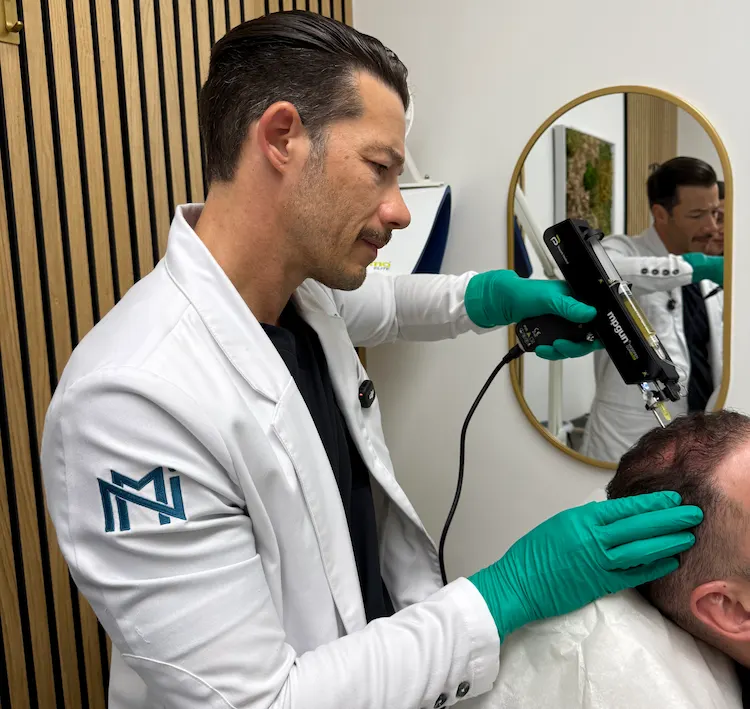
In plain terms: a small amount of your own blood is drawn, spun in a machine to concentrate the healing proteins inside your platelets, and injected into your scalp where hair is thinning. The whole procedure is done in the clinic and typically takes less than 60 minutes.
Platelet-rich plasma (PRP) therapy is a physician-administered regenerative treatment derived entirely from the patient’s own blood. No donor material is involved. The centrifuge process concentrates the platelets to levels significantly above what is found in normal circulation, and the resulting plasma is rich in growth factors that play documented roles in tissue repair and cellular activity.
The growth factors delivered through PRP therapy including PDGF (Platelet-Derived Growth Factor), VEGF (Vascular Endothelial Growth Factor), EGF (Epidermal Growth Factor), IGF-1 (Insulin-like Growth Factor 1), and TGF-β (Transforming Growth Factor-Beta) have demonstrated roles in hair follicle biology. Research suggests these growth factors may support follicle vascularity, prolong the active growth phase of the hair cycle, and contribute to a healthier scalp environment.
One important distinction: PRP does not address the hormonal driver of male pattern hair loss the way finasteride does. What PRP may do is support the tissue environment around existing follicles and potentially slow the progression of miniaturization in follicles that are still active. It is not a cure for male pattern baldness. It is a physician-evaluated supportive intervention for patients whose follicles retain biological activity.
What Does the Research Actually Show?
The clinical literature on PRP for male pattern hair loss has grown significantly over the past decade. Multiple peer-reviewed randomized controlled trials and systematic reviews have assessed PRP for hair loss in Miami patients and men with androgenetic alopecia broadly.
Key findings from published research include:
Hair count and density: Multiple studies have reported statistically significant increases in hair count, hair density, and hair shaft diameter in men receiving PRP compared to placebo or no treatment. A systematic review in peer-reviewed dermatology literature confirmed PRP produces measurable improvements in hair density for patients with androgenetic alopecia.
Growth factor mechanism: The growth factors in PRP, particularly PDGF and VEGF, have demonstrated roles in promoting follicle vascularity and extending the active growth phase of the hair cycle. This provides a biologically sound explanation for the improvements observed in clinical trials.
Safety: Because PRP comes from the patient’s own blood, the risk of systemic adverse reaction is low. The most commonly reported side effects are mild scalp discomfort, temporary redness, and swelling at injection sites, all of which typically resolve within 24 to 48 hours.
The honest context: The evidence is encouraging but not yet at the level required for universal standard-of-care designation. Study protocols vary in preparation methods, injection techniques, and patient populations. Results vary between patients. PRP is not effective for every man or every stage of hair loss. At NeoMedicine Institute, candidacy is always determined through physician evaluation and not assumed based on a hair loss pattern alone.
The Best Time to Act Is Before It Gets Worse
The best time to explore PRP for hair loss in Miami is before it gets worse — not after.
Most men wait until hair loss is obviously visible before seeking evaluation. By that point, a portion of the follicles in the thinning areas may have already transitioned from miniaturized to dormant. Dormant follicles are significantly less likely to respond to non-surgical intervention than follicles that are still active but shrinking.
PRP therapy is generally evaluated for men in earlier to moderate stages of androgenetic alopecia where follicles remain biologically active. At advanced stages the clinical rationale for PRP is significantly weaker.
This is not a reason to panic at the first sign of a receding hairline. It is a reason to get a physician evaluation sooner rather than later so that the clinical picture can be properly assessed while meaningful options are still on the table.
Men across Miami-Dade and Broward County including those in Coral Gables, Brickell, Miami Beach, Doral, Aventura, Kendall, Hialeah, Sunny Isles Beach, Hallandale Beach, and Pembroke Pines are encouraged to schedule a physician evaluation at NeoMedicine Institute before assuming surgery is the only answer.
PRP vs Hair Transplant Surgery: Which One Is Right for You?
This is the question most men researching hair loss in Miami eventually ask. The honest answer is that it depends entirely on where you are in the process.
Hair transplant surgery relocates existing follicles from a donor area, typically the back and sides of the scalp, to areas of thinning or baldness. It is a surgical procedure requiring local anesthesia and a recovery period. Surgery is most appropriate for men with advanced androgenetic alopecia who have sufficient donor hair and realistic expectations about what surgery can achieve.
PRP therapy is non-surgical and minimally invasive. It does not relocate or create new follicles. What it may do is support the health and activity of existing follicles in areas of early to moderate thinning. PRP is generally evaluated for men who are not yet surgical candidates, who want to delay surgery, or who want to explore non-surgical options first.
The two are not mutually exclusive. In some cases PRP may be evaluated alongside other interventions, though every decision is made through individual physician evaluation.
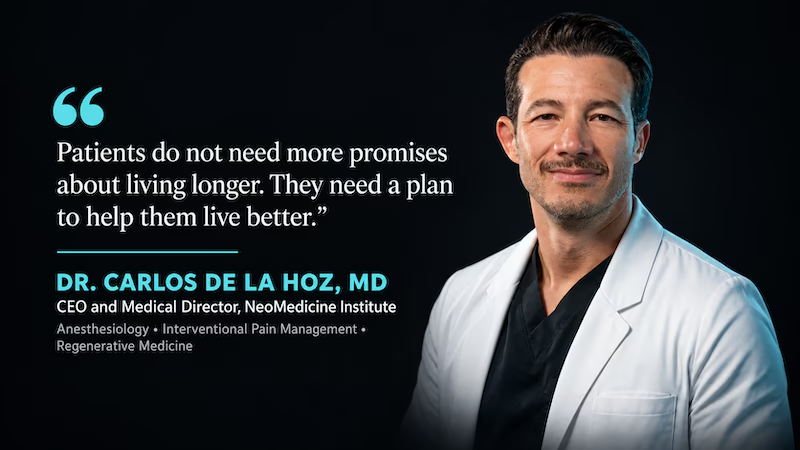
At NeoMedicine Institute, Dr. Carlos De La Hoz, MD does not recommend PRP as a replacement for surgery in men with advanced hair loss where surgical intervention is clinically appropriate. What he does offer is an honest physician evaluation to determine what is actually right for each individual patient.
What to Expect at NeoMedicine Institute
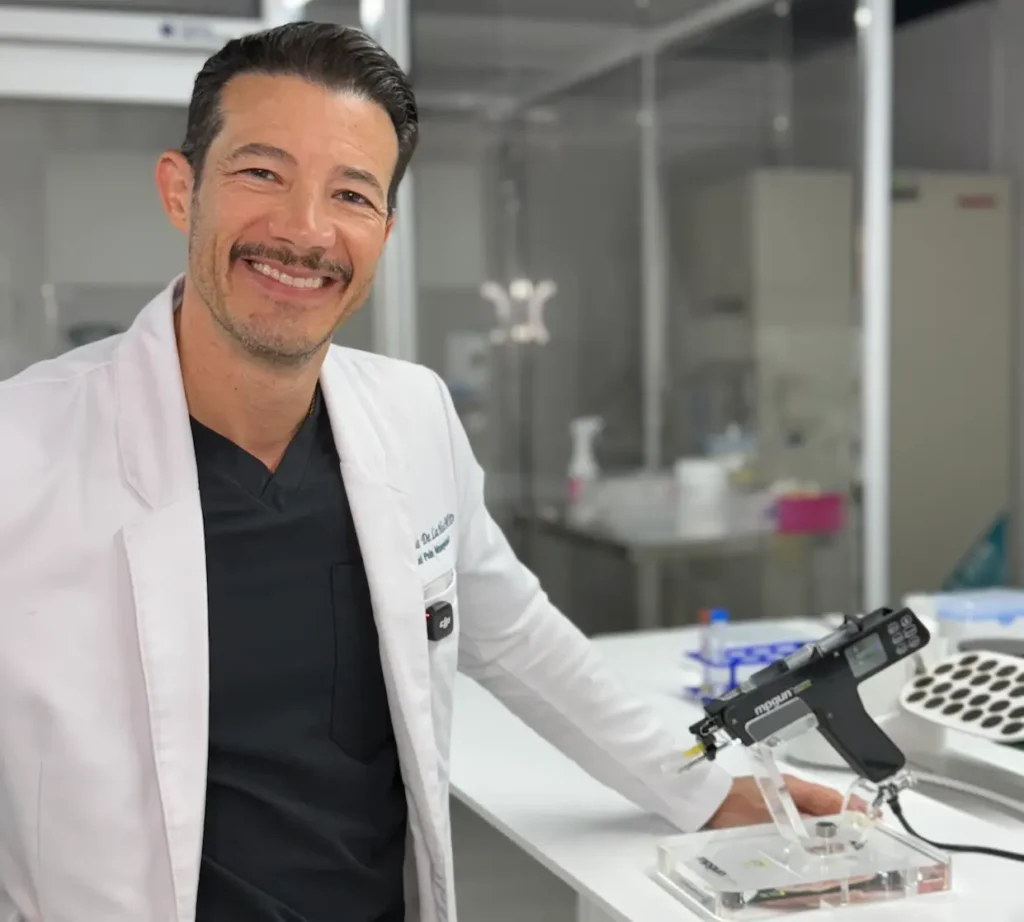
At NeoMedicine Institute, PRP therapy for male hair loss is evaluated and administered personally by Dr. Carlos De La Hoz, MD. Dr. De La Hoz is triple board-certified in anesthesiology (American Board of Anesthesiology, 2013), pain medicine (American Board of Pain Medicine, 2020), and regenerative medicine (American Board of Regenerative Medicine, 2021). His training in regenerative medicine includes the clinical application of platelet-rich plasma therapy across orthopedic, musculoskeletal, and hair restoration indications.
Every evaluation before PRP hair loss treatment at NeoMedicine Institute includes:
- A review of personal and family health history related to hair loss
- Assessment of the hair loss pattern and Hamilton-Norwood classification
- Evaluation of the degree of follicle miniaturization in affected areas
- Review of any prior treatments including topical or oral medications
- Assessment of hormonal and metabolic factors that may be contributing to hair loss
- An honest clinical discussion of what PRP may and may not achieve for that specific patient
The number of sessions is never predetermined. Additional treatments are only recommended when the physician evaluation between sessions indicates a clinical basis for continuing. No packages are prescribed in advance.
NeoMedicine Institute serves men across Miami-Dade and Broward County including patients from Doral, Aventura, Coral Gables, Brickell, Miami Beach, Kendall, Hialeah, Sunny Isles Beach, Bal Harbour, Hallandale Beach, Pembroke Pines, Weston, and across the United States. Both locations are accepting new patients and no referral is required.
Other Factors That May Be Contributing to Your Hair Loss
Hair loss in men is not always purely genetic. Dr. Carlos De La Hoz evaluates each patient’s full health profile before making any recommendation because several systemic factors can accelerate or contribute to hair thinning alongside DHT-driven follicle miniaturization.
Factors that may be evaluated alongside PRP candidacy include:
- Testosterone and DHT levels — hormonal imbalances can accelerate follicle miniaturization
- Thyroid function — thyroid disorders are a common and often overlooked contributor to hair thinning in men
- Iron and ferritin levels — deficiencies are frequently associated with diffuse hair loss
- Inflammatory markers — chronic inflammation can affect scalp health and follicle function
- Overall metabolic health — metabolic dysfunction can influence hair cycle regulation
For some patients, hormone optimization may be relevant alongside PRP evaluation. At NeoMedicine Institute, hormone optimization is available as part of a broader longevity and regenerative medicine program coordinated by Dr. Carlos De La Hoz. No combination of treatments is assumed or prescribed as a package. Every recommendation reflects the individual patient’s clinical findings and goals.
Frequently Asked Questions — PRP for Hair Loss in Miami
PRP therapy may support follicle activity and slow the progression of male pattern hair loss in men with early to moderate androgenetic alopecia where follicles remain biologically active. Clinical research has shown measurable improvements in hair count and density following PRP treatment. Results vary between patients and PRP is not effective for every type or stage of hair loss. Whether PRP is appropriate for your specific presentation is determined through physician evaluation at NeoMedicine Institute.
For men in earlier to moderate stages of androgenetic alopecia, PRP is a clinically supported non-surgical option worth evaluating before committing to surgery. PRP and hair transplant surgery serve different clinical purposes — PRP supports existing follicle activity while surgery relocates follicles from donor areas. At NeoMedicine Institute, Dr. De La Hoz evaluates each patient individually to determine which approach is appropriate for their specific stage and pattern of hair loss.
No — it is actually the ideal time. PRP therapy is most effective when follicles are miniaturized but still biologically active, which corresponds to earlier stages of male pattern baldness. Waiting until hair loss is advanced reduces the potential benefit of non-surgical intervention. Men noticing early thinning at the temples, crown, or hairline are encouraged to seek a physician evaluation sooner rather than later.
The number of sessions is determined through physician evaluation between each treatment and is never predetermined at the start of care. At NeoMedicine Institute, additional sessions are only recommended when the clinical assessment between treatments indicates a basis for continuing. Patients are never prescribed a package of sessions in advance.
PRP therapy is primarily evaluated for androgenetic alopecia, male pattern baldness driven by genetics and DHT. It is not appropriate for all types of hair loss. Alopecia areata, telogen effluvium, scarring alopecia, and hair loss from medical treatments or systemic conditions require different clinical evaluation. Whether your specific hair loss pattern makes you a candidate for PRP is determined through physician evaluation at NeoMedicine Institute.
PRP therapy for hair loss is generally not covered by health insurance as it is classified as a cosmetic or elective treatment for most hair loss indications. Patients are encouraged to contact NeoMedicine Institute directly to discuss pricing and payment options based on their individual treatment plan.
PRP for hair loss in Miami is available at NeoMedicine Institute’s Doral clinic at 2510 NW 97th Ave, Suite 110, Doral FL 33172 and the Aventura clinic at 2820 NE 214th St, Suite 801, Aventura FL 33180. NeoMedicine Institute serves patients across Miami-Dade and Broward County including Coral Gables, Brickell, Miami Beach, Kendall, Hialeah, Sunny Isles Beach, Hallandale Beach, and Pembroke Pines. No referral is required and both locations are accepting new patients.
Schedule a Hair Loss Evaluation at NeoMedicine Institute
Male pattern hair loss is progressive. Acting earlier keeps more options on the table. At NeoMedicine Institute, Dr. Carlos De La Hoz, MD evaluates each patient’s hair loss pattern, health history, hormonal status, and degree of follicle activity before making any treatment recommendation. No sales pitch. No preset packages. Just a physician evaluation that tells you honestly where you stand and what your options are.
No referral required. Locations in Doral and Aventura, FL. Serving patients across Miami-Dade and Broward County.