Both platelet-rich plasma (PRP) therapy and stem cell therapy are physician-guided regenerative treatments offered at NeoMedicine Institute. They are frequently discussed together and frequently confused. While both fall under the umbrella of regenerative medicine, they work through different biological mechanisms, are prepared differently, and are evaluated for different clinical scenarios. Understanding those differences is the starting point for any informed conversation with a physician about which approach, or combination of approaches, may be appropriate for a specific patient and condition. At NeoMedicine Institute, PRP vs stem cell therapy is one of the most common questions patients bring to their first physician evaluation — and the answer is never one-size-fits-all.
How PRP and Stem Cell Therapy Work Differently
PRP: Growth Factor Delivery
PRP concentrates platelets from a patient’s own blood and delivers a high volume of bioactive proteins including PDGF, TGF-β, VEGF, EGF, and IGF-1 directly to a targeted area. These growth factors support the tissue healing environment by stimulating cell activity, reducing inflammation, and promoting repair at the site of injury. PRP does not introduce new cells into the tissue. It amplifies the signals that direct the body’s existing repair mechanisms.
Stem Cell Therapy: Cellular Regeneration
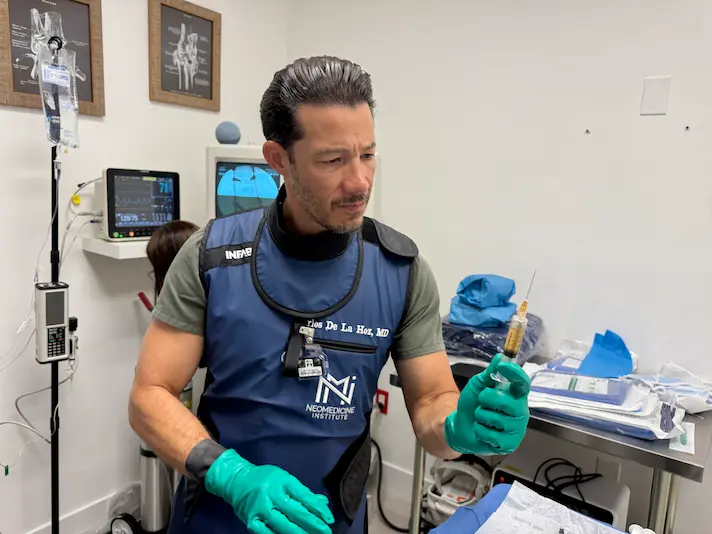
Stem cell therapy introduces biologic material collected from the patient’s own body into the treatment area. At NeoMedicine Institute, stem cells are collected from the patient’s own peripheral blood, bone marrow aspirate concentrate (BMAC), or adipose tissue. Unlike PRP, stem cell therapy delivers cells that have the capacity to differentiate into specific tissue types and to release their own growth factors and signaling proteins. The regenerative potential of stem cell therapy extends to tissue environments where the body’s natural repair capacity is more limited.
PRP vs Stem Cell Therapy: The Key Difference
PRP works by concentrating and delivering healing signals. Stem cell therapy works by introducing cellular material with regenerative and signaling properties. Both operate through the patient’s own biology. Neither involves synthetic drugs, surgical intervention, or donor material.
When Is PRP Typically Considered?
Physicians generally evaluate PRP as a first-line regenerative option for conditions where the tissue environment retains some natural healing capacity and the primary need is to amplify the repair signal. Clinical scenarios where PRP is commonly evaluated include:
Early to moderate osteoarthritis particularly of the knee, hip, and shoulder joints where cartilage degeneration has not yet reached end-stage.
Tendon injuries including rotator cuff tendinopathy, Achilles tendinopathy, patellar tendinopathy, and lateral epicondylitis.
Ligament sprains including partial tears of the ACL, MCL, and ankle ligaments.
Muscle strains in active patients recovering from acute and overuse injuries.
Plantar fasciitis in patients with chronic heel pain that has not responded to conservative care.
Post-surgical support where PRP may be evaluated to support tissue healing following certain surgical procedures.
PRP is also typically faster to prepare, involves a simpler procedure, and is generally a lower-cost entry point into regenerative care. This makes it a clinically appropriate first evaluation in many cases.
When Is Stem Cell Therapy Typically Considered?
Physicians generally consider stem cell therapy when the clinical picture calls for a more intensive regenerative approach. This includes cases where tissue damage is more extensive, such as advanced joint degeneration, larger tendon or ligament tears, or conditions where PRP alone may not provide sufficient regenerative stimulus.
It is also evaluated when conservative and initial regenerative treatments have not produced adequate results. Stem cell therapy may be considered after PRP has been attempted and the clinical response assessed by the physician.
Post-surgical recovery is another common scenario. Stem cell therapy can be evaluated to support healing in tissue environments that have undergone surgical intervention, where additional regenerative support may enhance recovery outcomes.
Chronic degenerative conditions including long-standing osteoarthritis, disc degeneration, and conditions with significant tissue loss may also be candidates for stem cell evaluation.
At NeoMedicine Institute, stem cell therapy is performed using the patient’s own biological material collected from peripheral blood, bone marrow, or adipose tissue. Dr. Carlos De La Hoz evaluates each approach individually based on the patient’s specific clinical findings.
Can PRP and Stem Cell Therapy Be Combined?
Yes. In certain clinical scenarios, a combined approach may be evaluated. At NeoMedicine Institute, Dr. Carlos De La Hoz may recommend PRP and stem cell therapy as part of the same treatment plan when the patient’s clinical picture supports it.
In some cases, stem cell therapy is administered first to deliver the cellular regenerative stimulus, with PRP following several weeks later to support and amplify the healing environment as the tissue responds. In other cases, PRP is evaluated first and stem cell therapy is introduced as a next step based on how the patient responds clinically.
The sequence and combination of both treatments is determined entirely through individual physician evaluation at NeoMedicine Institute. No combined protocol is applied as a standard package.
How Does a Physician Determine Which Approach Is Right?
This is the question most patients ultimately want answered. It is one that cannot be answered without a physician evaluation. At NeoMedicine Institute, the evaluation process includes a review of health history and prior treatments, diagnostic imaging when appropriate, a physical examination of the affected area, and an assessment of the patient’s overall health, activity level, and treatment goals.
Dr. Carlos De La Hoz does not apply a predetermined protocol to any patient. The choice between PRP, stem cell therapy, or a combination approach reflects what the individual patient’s clinical findings support. It is not a menu-based recommendation or a revenue-driven package. Patients who have had a prior evaluation elsewhere, including those who have been told they need surgery, are welcome to schedule a consultation at NeoMedicine Institute for an independent physician assessment.
A Note on Stem Cell Banking
One consideration that extends beyond the immediate treatment decision is Adult Stem Cell Banking. Regardless of whether a patient chooses PRP or stem cell therapy today, the option to preserve their own stem cells for potential future use is available now. The biological case for doing so is time-sensitive.
Stem cell quality and quantity decline with age. The cells a patient can bank today, from peripheral blood, bone marrow, or adipose tissue, are biologically younger and more viable than those that could be collected five or ten years from now. Banking stem cells does not require any immediate treatment decision. It is a proactive step that preserves future options.
NeoMedicine Institute offers stem cell banking as a standalone service. Patients considering any regenerative treatment are encouraged to ask Dr. Carlos De La Hoz about banking during their evaluation. Learn why banking now matters

PRP vs Stem Cell Therapy: A Clinical Overview
PRP Therapy
- Source: Patient’s own blood
- Mechanism: Growth factor delivery
- Common use cases: Early arthritis, tendon injuries, ligament sprains
- Can be combined with stem cell therapy: Yes
- Evaluated by physician: Always
Stem Cell Therapy
- Source: Patient’s own peripheral blood, bone marrow, or fat
- Mechanism: Cellular regeneration and signaling
- Common use cases: Advanced degeneration, post-surgical, complex tissue damage
- Can be combined with PRP: Yes
- Evaluated by physician: Always
This is a general clinical overview. Individual candidacy depends on physician evaluation.
Frequently Asked Questions — PRP vs Stem Cell Therapy
Neither is universally better. The appropriate option depends on the severity of the knee condition, the patient’s health history, and what the physician determines through evaluation. Early to moderate knee osteoarthritis may be evaluated for PRP first. More advanced degeneration or larger structural damage may prompt evaluation for stem cell therapy. In some cases, both may be considered as part of a coordinated treatment plan.
Stem cell therapy and PRP work through different mechanisms and are evaluated for different clinical scenarios. Stem cell therapy generally offers a more intensive regenerative stimulus, but that does not make it universally more effective for every patient or every condition. PRP may produce the clinically appropriate result for a given patient without requiring stem cell therapy. Individual response varies.
In some cases, yes. At NeoMedicine Institute, Dr. De La Hoz may recommend a combined approach when the patient’s clinical picture supports it. The timing and sequence of each treatment is determined through physician evaluation and is not applied as a standard protocol.
The number of sessions is determined through physician evaluation between each treatment and is not predetermined at the start. At NeoMedicine Institute, additional sessions are only recommended when the clinical assessment indicates a basis for continuing. Patients are never prescribed a package of treatments in advance.
Schedule a Regenerative Medicine Evaluation at NeoMedicine Institute
The right regenerative approach, whether PRP, stem cell therapy, or a combination of both, depends on an individual physician evaluation. Dr. Carlos De La Hoz, MD evaluates each patient’s clinical findings, imaging, health history, and treatment goals before making any recommendation.